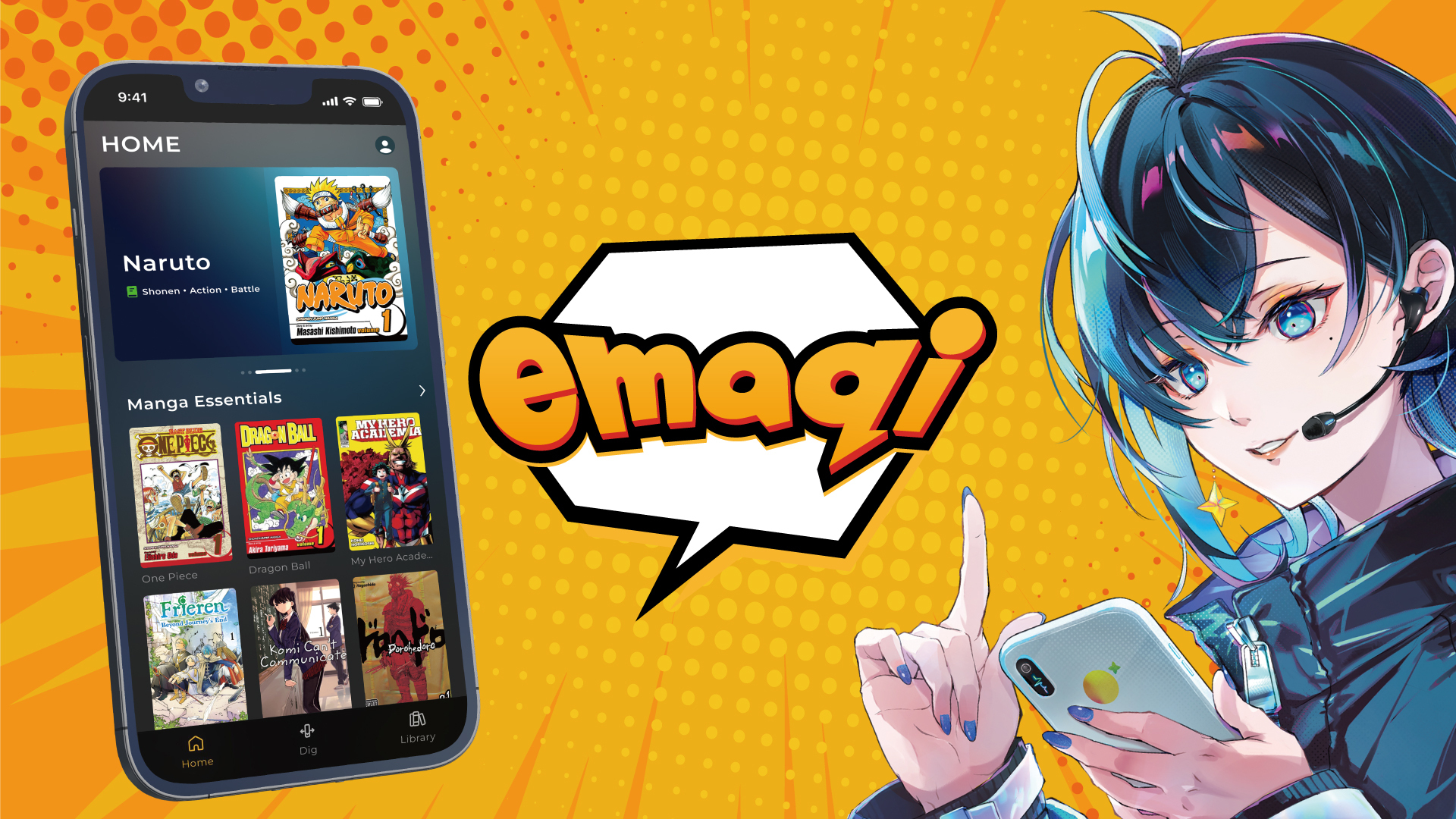
Leading up to Anime Expo 2026, Dorkaholics connected with the digital manga platform, emaqi, known for its massive library of over 13,000 officially licensed Japanese manga volumes across roughly 1,700 series. The company’s head of community growth, Amber Barton, was available for an interview where we got to know her as a manga-loving dork and what her career entails.
What made her a dork growing up was actually gaming, tabletop as well as computer-based, before she discovered anime.
“Ah, if only I knew how cool dorks would be when I grew up. At a young age I was exposed to gaming by my older brother, which was so not cool back then. He is also a massive dork as it turns out,” Amber recalled. “We played pen and paper D&D (Dungeons & Dragons), the Forgotten Realms Gold Box games on floppy disks and pinball machines at the laundry mat.”
And like many millennial dorks, Toonami played a role in bringing anime into her home.
“I was also watching anime from Blockbuster on VHS like Unico and The Little Mermaid (not the Disney one!), though I didn’t know it was anime at the time. I watched Power Rangers on my small black and white TV on Saturdays and eventually Toonami came along and with it, my understanding that anime was something special,” Amber shared. “Growing up liking these sorts of things during the 90s wasn’t particularly easy and didn’t make me very many friends, but at a certain point I realized that I wasn’t willing to give up what I liked to please others and here I am. Still being a massive dork haha. I’m glad young me chose to be stubborn and true to myself rather than chasing validation through other people.”
Her love of manga actually comes from her mother, who supported her interest despite not exactly sharing it.
“Manga reminds me of my mother, actually, whom I care very much for. She unintentionally exposed me to it for the first time through her job as the head of the Young Adults section at our local library. She didn’t really get that stuff I was into but she has always been super supportive and knew I like to draw. She saw the pretty pictures and strong female characters in a volume of Ah! My Goddess and thought I’d like to read it,” Amber said. “Honestly, I’ve never been able to get into American comics, maybe because back then it seemed to be made with someone else in mind, but something with manga just clicked with me from the start. She would probably later come to regret this decision somewhat as I started pestering her to buy me copies of Inuyasha every time we went to the bookstore and manga was quite expensive back then, at least for us.”
In her role as head of community growth at emaqi, she wears many hats of course including community-focused ones that serve the readers both online and in-person.
“At a high level I do the usual community tasks like building spaces for our readers to gather, planning, creating content and keeping an eye on our social channels and collaborating with the other marketing teams, but I also get to talk to a lot of manga and anime fans at the events we attend,” she explained. “emaqi has a mobile library called The Manga Truck we use for appearances at places like SF Sakura Matsuri, Fanime and Anime Expo, to name a few.”
And occasionally, she is able to provide feedback on translations.
“Sometimes I also get to provide feedback on English manga scripts by extremely talented translators before they’re released, which is both an amazing opportunity and a lot of fun!”

Insights that she’s gained through her experiences building communities around fandom such as gaming, anime, esports, and manga at companies such as Amazon Games, Kongregate, and Funimation include understanding what all fans have in common but also recognizing the highs and lows of the role.
“I’ve learned that people are fundamentally the same no matter where you go. People have things they’re passionate about, fandoms in this case, and they want to share that passion with others who feel the same. They also want to feel heard if you’re an official representative of the fandom,” Amber explained. “Being an official representative in Community for any fandom can be incredibly hard and emotionally taxing, usually for reasons completely out of your control.”
The highs and lows of working in community roles seems to be tied to the level of access being part of a company entails, but also whether or not those same matters can be shared with community members.
“I think it’s hardest when you empathize with a member of your community, but you can’t give them the information they want to hear for one reason or another, and of course you can’t tell them why. On the other hand, it can be incredibly rewarding when you do get to deliver good news or get to help turn someone’s bad day around,” Amber said. “They are two extremes that a job in Community moves between but in the end, the good parts always feel worth it.”
When it comes to guiding new fans towards community, she recommended in-person places as well as digital hubs.
“We’re lucky to be living in a time where we’re all so interconnected, it’s relatively easy to find groups of like minded people both online and in person. Bookstores, new and used stores, are great places to find groups who meet up regularly in person to discuss any number of topics. And if they don’t have a club, maybe you could start one!” she explained. “Schools, colleges and universities also regularly have anime, gaming and manga clubs. Online there are subreddits and Discord servers for everything a mere search away.”
In addition to directing new fans in search of a community, she also shared general guidelines that can help navigate the experience of being a newcomer.
“Once you find a group you’re interested in, I think people should approach this the same way they should approach new people in general. Have self awareness that you are new and you may not understand everything going on or the unspoken rules yet,” she said. “Be confident but also have humility – don’t join a group and immediately try to make yourself the center of the conversation. Listen, watch and learn. A short introduction, followed by active listening and adding meaningful conversation will have you fitting in in no time.”
Being an older millennial manga fan, Amber also shared the experiences as a reader from the middle of the US during her youth.
“I think how each person perceives how manga fandom has evolved in their lifetime depends largely on where they lived in the US. For me, I didn’t live on either the East or West Coasts growing up and most of the places I lived did not have large Asian populations. Because of this, manga was relatively rare. Outside of pestering my mother to either bring more manga into the library she worked at or to buy me copies when I could find any at the local bookstores, there really weren’t any other chances to read manga,” Amber shared. “It wasn’t until I moved to Chicago when I went to university there that I had the opportunity to visit massive bookstores or Japanese bookstores like Kinokuniya. That first time (and every time afterwards, honestly) has always been amazing.”
In addition, she also highlighted the wider accessibility of anime compared to manga and how fans typically move in their consumption of characters and stories, as well as that impact that drives manga piracy and fan translations.
“It seems to me that this experience is very common for older millennial aged US manga fans, especially those who didn’t grow up in California or New York. Anime actually became more widely accessible before manga for a lot of us and I think you can still see that today reflected in US anime and manga culture – a lot of people watch an anime first and then will read the manga if they’re super interested, instead of the other way around,” Amber said. “The long term inaccessibility of manga has also contributed to how widespread manga piracy and fan translations are even to this day. I don’t think people do these things to be malicious, they’re consuming manga the only way they knew how to for a long time.”
Manga she is currently reading includes Frieren, The Apothecary Dairies, Izakaya of Extinct Animals, Curious People: Welcome to the Folklore Club, Monster Cats, and Please Look After the Dragon.
Her manga recommendations include Ōten no Mon and Hozuki’s Coolheadedness.
“I have a weakness for manga involving ghosts, mysteries, strange folklore, and people making terrible decisions around all three. One title I wish more people knew about is Ōten no Mon, a historical mystery series about an unlikely duo solving cases in Heian-era Japan. It’s smart, atmospheric, and the character chemistry is fantastic,” Amber suggested. “I’d also recommend Hozuki’s Coolheadedness. Imagine being the manager of Hell and spending your days solving problems caused by demons, mythical creatures, and the occasional historical figure. That’s basically Hozuki’s job, and it’s as hilarious as it sounds. Neither series gets nearly enough attention outside Japan, which is a shame because they’re exactly the kinds of books I end up recommending to everyone.”
And for newcomers or first time manga readers, she recommends Neko ni Tensei Shita Oji-san or The Vampire Dies in No Time.
“The premise is delightfully ridiculous: a middle-aged salaryman suddenly reincarnates into a cat. What starts as a joke quickly becomes a surprisingly warm and charming story about family, friendship, and learning how to appreciate the people around you. It’s one of those rare series that’s both funny and genuinely comforting,” Amber said. “For something on the opposite end of the chaos spectrum, I’d pick The Vampire Dies in No Time. It’s built around the simple idea that its supposedly terrifying vampire protagonist dies constantly and for the most absurd reasons imaginable. Every chapter somehow manages to escalate the nonsense even further, and the cast is packed with wonderfully strange characters. If a manga can make me laugh out loud when I’m reading alone, that’s usually a good sign, and this one does it regularly.”