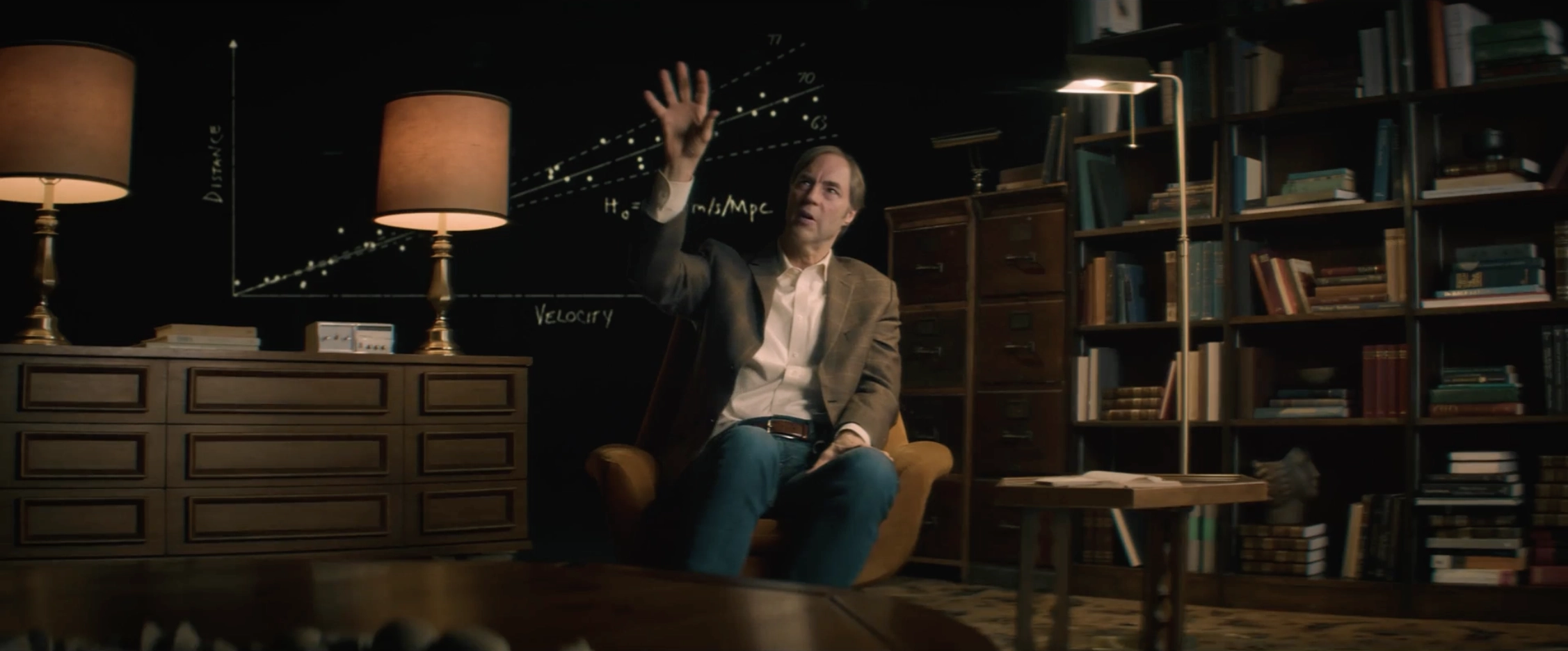
What happens when science starts asking the same questions as philosophy, and maybe even theology? That’s exactly where “The Story of Everything” lands. The upcoming docufilm, led by physicist and philosopher Stephen Meyer, explores whether modern discoveries in physics, biology, and cosmology point toward something bigger than chance: design.
Ahead of the film’s theatrical release on April 30, I spoke with Meyer about his lifelong curiosity, the intersection of science and philosophy, and why this conversation is more relevant now than ever.
“I Was the Kid Selling Bugs Instead of Lemonade”
Before diving into the origins of the universe, Meyer’s story starts somewhere much simpler: childhood curiosity.
“I was fascinated with insects, fossils, and dinosaurs,” Meyer shared. “I even set up a bug collection stand when I was 10… while other kids were selling lemonade.”
It didn’t exactly take off as a business venture, but it cemented something important. That early fascination with science never left.
Today, Meyer jokes that he’s still chasing the same idea his grandson described perfectly: becoming an “everything-ologist.”
And honestly? That tracks.
A Film That Bridges Science and Philosophy
“The Story of Everything” is an interdisciplinary exploration of some of humanity’s biggest questions:
- Where did the universe come from?
- Why does it appear “fine-tuned” for life?
- How did life itself begin?
According to Meyer, you can’t answer those questions with science alone.
“It’s a scientific book that explores the philosophical implications of scientific discoveries,” he explained, referencing his work, “Return of the God Hypothesis”.
That distinction matters. The data may come from science, but interpreting what it means? That’s where philosophy enters the chat.
When Science Stops Being Compartmentalized
One of the film’s core ideas challenges a long-standing assumption: that science and philosophy should stay in separate lanes.
Meyer argues that approach is outdated.
“The attempt to separate scientific knowledge from other kinds of knowledge… didn’t really work,” he said.
Instead, “The Story of Everything” embraces overlap, letting scientists reflect on what their discoveries actually imply.
And that’s where things get interesting.
DNA, Binary Code, and a “Mic Drop” Moment
One of the most compelling moments in the film compares DNA to digital code, a concept that is familiar for anyone with a tech background.
Meyer pointed to early insights from George Gamow, who recognized that DNA’s structure could be translated into binary.
“You realize… this is the kind of thing we know minds produce,” Meyer said. “And no other cause.”
That idea, information as a signature of intelligence, is central to the film’s argument for intelligent design.
Why Peter Thiel Is in the Film
Yes, that Peter Thiel.
While it might seem random at first, his presence makes more sense when you consider the film’s themes. As a technologist, Thiel offers a perspective on how biological systems resemble engineered systems.
“The technology inside cells… is something engineers are uniquely positioned to comment on,” Meyer explained.
It’s another example of the film’s cross-disciplinary approach, bringing together physicists, biologists, philosophers, and technologists to tackle the same questions.
From a 500-Page Book to a Cinematic Experience
Adapting Meyer’s dense, 500+ page work into a feature-length documentary wasn’t easy, but the result is something designed for accessibility.
“You have to distill it,” Meyer said. “There are over 400 visual effects; it’s a completely different way of communicating ideas.”
Translation: this isn’t just a lecture. It’s meant to be experienced.
And according to Meyer, seeing it on the big screen makes a difference.
Could There Be a Story of Everything Part 2?
Short answer: absolutely.
Each major section of the film could stand on its own:
- The origin of the universe
- The origin of life
- The sudden appearance of complex organisms (explored in Darwin’s Doubt)
“Each chapter could warrant its own film,” Meyer said.
So this might just be the beginning.
Where to Go Next If You’re Curious
If “The Story of Everything” gets you thinking, Meyer recommends diving deeper into related works:
- The Devil’s Delusion
- Undeniable
- Darwin’s Black Box
- The Privileged Planet
He also highlights thinkers like John Lennox and James Tour as key voices in this space.
Final Thoughts: Embracing the “Dork” in Big Questions
At its core, “The Story of Everything” is about curiosity, the kind that doesn’t stop at easy answers.
It’s about asking bigger questions, even when they blur the lines between disciplines.
And maybe, just maybe, it’s about being okay with not having everything neatly categorized.
“I can’t think of anything more interesting to study,” Meyer said. “But then… I’m kind of a dork.”
Same here.
The Story of Everything Release Date
“The Story of Everything” hits theaters on April 30, 2026. Get your tickets here.
[INTERVIEW TRANSCRIPT EDITED FOR CLARITY]
Neil Bui: At Dorkaholics, we believe there’s a dork in everyone, and it’s our job to bring that dork out into the world. So I’ve got to start with this: what made you a dork growing up?
Stephen Meyer: Absolutely. When I was very young, I was fascinated with insects, fossils, and dinosaurs. My sister tells this story every Christmas about me as a 10-year-old creating a bug collection, pinning and labeling everything, and setting it up on the street while other kids had lemonade stands.
I was crestfallen when no one wanted to pay to look at my bugs. She always starts with, “My brother was such a nerd…” and then doubles over laughing.
So yeah, that’s where it started. By four, I was already dinosaur-crazy.
Neil Bui: That tracks, especially since the film spans so many scientific fields, from cosmology to molecular biology. It’s interesting that even early on, you were into multiple disciplines.
Stephen Meyer: Yeah, pretty much all of them. But also the philosophical questions started to haunt me around age 14.
I actually have a grandson now who said he wants to be an “everything-ologist.” I love that. I majored in physics and geology, did a PhD in philosophy of science, and wrote my thesis on origin-of-life biology.
So I’ve always been interested in the intersection of science and deeper philosophical questions, epistemology, metaphysics, all of it. I aspire to be an everything-ologist, but no one can fully pull that off.
Neil Bui: It sounds like you’re trying.
Stephen Meyer: That’s why there are 22 other scientists in the film, we needed a lot of expertise.
Neil Bui: One of the surprising faces in the documentary was Peter Thiel. What was it like getting him involved?
Stephen Meyer: He accepted pretty readily. He’s been a longtime skeptic of what he calls the “church of atheism” in academia. He’s a theist, studied biophysics at Stanford, then law, and is obviously a leading technologist.
We wanted someone grounded in real-world technology because so much of what’s happening in living systems resembles engineering. There’s even research showing that cellular communication mirrors internet design logic.
So having someone like him comment on that intersection made sense, and he gave some great insights, especially on the multiverse.
Neil Bui: The film blends philosophy and science. Would you say your book, “Return of the God Hypothesis”, is more philosophical or scientific?
Stephen Meyer: It’s primarily scientific, but it explores the philosophical implications of scientific discoveries.
Questions about the origin of the universe, fine-tuning, and life itself require scientific groundwork. But interpreting what those findings mean, that’s philosophical.
The idea that science and philosophy should be completely separate comes from early 20th-century positivism, and that framework has largely collapsed. This film reflects that shift, scientists are now engaging with the philosophical implications of their work.
Neil Bui: One moment that stood out was how DNA was compared to binary code. As someone with a computer science background, that hit differently.
Stephen Meyer: Exactly. That realization goes back to physicist George Gamow, who saw that DNA sequences could be expressed in binary terms.
That’s a powerful moment, you realize this resembles information systems we associate with intelligent design. It raises the question: what kind of cause produces this kind of effect?
Neil Bui: Watching the film helped me see how science and theology can overlap, especially when discussing the origin of the universe.
Stephen Meyer: Right, and I’d push back on the idea that that’s something to worry about.
If scientific evidence points toward a mind with attributes traditionally associated with God, why should that be off-limits? The resistance comes from the assumption that knowledge must be compartmentalized, but that doesn’t hold up.
The same reasoning methods, like inference to the best explanation, are used across science, philosophy, history, even detective work.
Neil Bui: Your book is over 500 pages, this film feels like a distilled version.
Stephen Meyer: Exactly. You have to distill it. The filmmakers did an incredible job, over 400 visual effects, and some ideas are better conveyed visually than in text.
But of course, the book goes deeper. The film is an entry point; the book expands on the arguments and evidence.
Neil Bui: If there were a sequel, “The Story of Everything Part Two”, what topics would you explore?
Stephen Meyer: Each act of the film could be its own movie.
- The origin of the universe and competing cosmological models
- The origin of life
- My book Darwin’s Doubt, which examines the sudden appearance of animal life in the fossil record
There’s a lot more to explore.
Neil Bui: For viewers who want to go deeper, where should they start?
Stephen Meyer: The book is a good next step, but it synthesizes a lot of other work.
Some great follow-ups include:
- The Devil’s Delusion
- Undeniable
- Darwin’s Black Box
- The Privileged Planet
Also, thinkers like John Lennox and researchers like James Tour offer deeper insights into these topics.
The film is really a gateway into a much larger conversation.