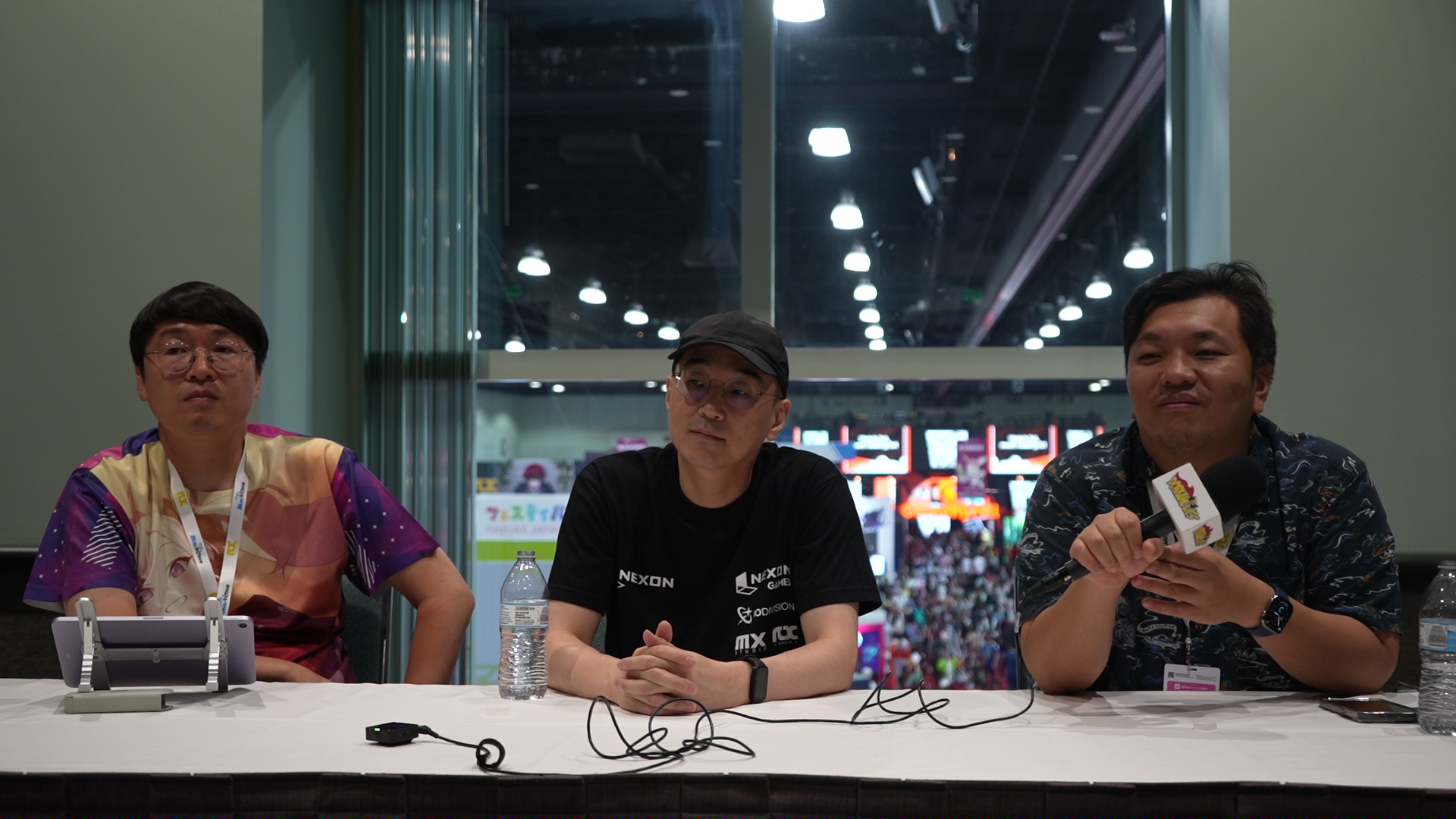
Whether discussing Blue Archive’s optimistic storytelling, one of the game’s most beloved characters, or Project RX’s experimental Anime Expo booth, the IO Division leadership team would return to the same philosophy of creating emotional connections between players and the worlds they create.
“Our goal is to create worlds that players genuinely want to experience, and then allow players to experience those worlds in real life as well,” Kim Yong-ha, Executive Project Director of Blue Archive and Head of NEXON Games’ IO Division, told Dorkaholics. “One of the defining characteristics of our division is that everyone here loves these kinds of worlds.”
Kim even compared Anime Expo itself to an isekai brought into reality as it’s a place where fans can temporarily step inside the kinds of worlds they normally only experience through games and anime.
Choosing Hope Instead of Dystopia
Modern action games frequently lean toward darker settings filled with war, destruction, and survival. Kim said IO Division intentionally wanted to explore another direction.
“We wanted to show a brighter kind of isekai,” Kim explained. “Even in a brighter world there will always be conflict, but we wanted to show how those conflicts can be overcome while highlighting the positive aspects of reality.”
Rather than relying solely on dramatic settings, Kim believes relatable characters are what ultimately resonate with players.
“Our characters connect with players because they contain elements that players can relate to in real life.”

Blue Archive’s Influence Goes Beyond the Game
When asked how Blue Archive has influenced the gaming industry, Kim didn’t point to downloads or revenue. Instead, he pointed to creativity.
“Blue Archive adapted the anime school-life genre into a game,” Kim said “Since then, I think more developers have begun creating brighter styles of games than before.”
He also believes one of the game’s greatest accomplishments has been the strength of its fan community.
“One of Blue Archive’s defining characteristics is how active its fan-created works are,” Kim said. “I think other developers now consider how their own character designs can inspire that kind of creativity.”
That observation is particularly meaningful within anime culture, where fan art, cosplay, music, and doujinshi often become indicators of a franchise’s long-term cultural impact.

Kei Became One of Blue Archive’s Biggest Success Stories
The conversation naturally turned to the character Kei, whose release quickly became one of Blue Archive’s defining moments. According to Lee Jun-ho, Deputy Project Director of Blue Archive, the response from Japanese fans exceeded every expectation.
“When Kei was announced during our offline event in Japan, the cheers were louder than for any other student,” Lee told Dorkaholics. “The decibel level was the highest of the entire event.”
- Editor’s Note: In Blue Archive, students are the playable characters and central figures who live, study, and fight in the academy city of Kivotos.
The excitement extended well beyond the audience.
“Kei’s voice actress cried,” Lee recalled. “She already knew Kei’s story, and when she saw the players’ reaction, she became emotional as well.”
Perhaps the clearest sign of Kei’s popularity came outside the game itself.
Lee noted that Kei became only the second character ever to earn the fan-given title of “Queen of Ariake,” recognizing the character with the largest dedicated presence at Comiket. According to Lee, Kei even surpassed the previous record holder in the number of fan-created circles dedicated to the character.

Story Still Comes First
Although Blue Archive has become known for its gameplay systems and memorable cast, Lee emphasized that emotional storytelling remains the team’s highest priority.
“The first part of the story focused on the responsibility of adults and the salvation of the students,” Lee explained. “Our goal is to continue delivering that same emotional experience in Parts Two and Three.”
He admitted the development team shed plenty of tears while creating the story and hopes players will continue experiencing those same emotions as the narrative expands.

Project RX Begins with Emotion
While many studios introduce a new IP by discussing gameplay systems, Cha Min-seo, Project Director of Project RX, began somewhere else entirely – relationships.
- Editor’s Note: Since Anime Expo 2026, the official title for Project RX has been revealed to be FAREIDOLIA, a misspelling of pareidolia, which means ‘the tendency to perceive a specific, often meaningful image in a random or ambiguous visual pattern’
“The biggest thing players can expect is that we’re trying to reduce the emotional distance between players and the characters,” Cha told Dorkaholics.
That philosophy shaped everything IO Division showcased during Anime Expo. Rather than building a traditional gameplay demo, the team created an interactive booth designed to encourage players to communicate directly within a character.
“What’s important isn’t whether you’re playing Rock-Paper-Scissors,” Cha said. “It’s whether that interaction creates a new emotional experience. If it does, we believe that’s a meaningful way to introduce a new IP.”
Kim added that removing the traditional controller was equally intentional.
“The character responds directly to your voice,” Kim said. “If players make eye contact, greet the character, and respond naturally, they’ll experience a greater sense of immersion and excitement.”
Looking Ahead
Although the team stopped short of announcing additional gameplay details or a release window for Project RX, Cha indicated that appearing publicly at Anime Expo reflects meaningful progress.
“The fact that we’re participating in Anime Expo means development has progressed quite a bit,” Cha said. “We’ll continue revealing more information, and we’d love for fans to keep sharing their feedback so we can continue improving the project.”