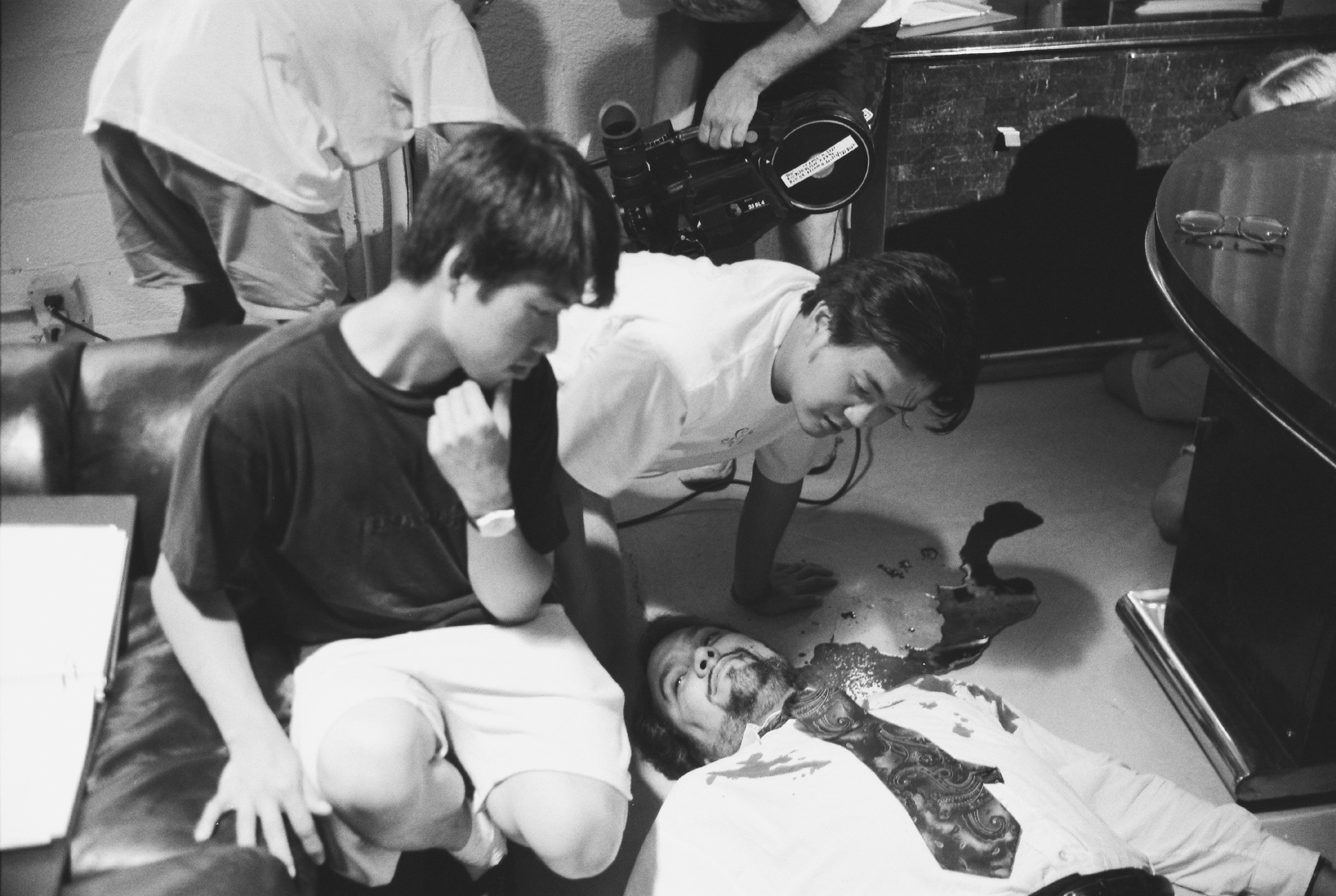
With a new book titled “Cinemasianamerica”, I reconnected with filmmaker Quentin Lee to reflect on their career that spans over three decades in Asian American and queer cinema. In addition to the book, there is a seven-day theatrical screening series running from May 1 to May 7 at Laemmle’s Royal in Los Angeles. From identity and representation to the evolution of storytelling, our conversation explored what it means to tell culturally challenging stories and why that still matters today.
Why “Asian American” Still Matters
Quentin emphasized that language plays a critical role in shaping identity, sharing a recent experience involving their son’s school where a racist incident occurred.
Reflecting on how the situation was addressed, they noted “Then I was thinking like, shouldn’t they say Korean American?” instead of “the Korean students.”
That distinction is more than just semantics, it speaks to identity, belonging, and how communities are recognized within American society.
Revisiting “Shopping for Fangs” and Its Identity Play
Quentin explained that their film, “Shopping for Fangs” was intentionally experimented, created in response to the dominant wave of Asian American films in the 1990s.
“Back then, all the Asian American films were dealing with, ‘Oh my God, I’m Asian’, and like all the identity stuff.”
Instead of following that path, they and their co-director Justin Lin (“Better Luck Tomorrow”, “The Fast and the Furious: Tokyo Drift”, “Fast & Furious 6”, “F9”, “Star Trek Beyond”, “Community”, “True Detective) set out to do something different.
“We set out to make a movie that’s very different from that, to put all these Asian American stereotypes, all these identities back into play.”
The result was a layered, unconventional film influenced by works like “Chungking Express”, one that challenges audiences to engage beyond the surface.
Trinh, Trauma, and the Vietnamese American Experience
One of the most compelling aspects of the film is the character of Trinh (also known as Katherine), whose backstory as a Vietnamese refugee carries emotional depth.
Quentin shared that this storyline was shaped by their interest in collective trauma, “I was really into the Middle Passage… when the slaves [were] being brought over… there’s a lot of these horrible things that happened that created this collective trauma.”
They connected that idea to the refugee experience, explaining how the character navigates assimilation, “she had to sort of give up her immigrant life… to integrate into a more… bougie kind of identity.”
That internal conflict, between past and present as well as identity and survival, becomes central to the story. As a Vietnamese American, heading that perspective added an entirely new layer of meaning for me.
Early Days with John Cho
Quentin recalled casting John Cho in what would become his first film role, “he was just fresh out of Berkeley and I thought, ‘oh, he’s the guy’.”
It wasn’t just about appearance, Cho’s English degree and background in Asian American studies stood out as well.
The Throughline: Stories about Connection
Across genres, whether comedy, horror, or drama, Quentin identified one consistent theme in their work, “the central theme is really about the main characters finding the connection to each other or the world.”
That idea reflects their own personal journey, “my journey always is trying to find a connection, so connection is really important to me.”
It’s a theme that resonates universally, grounding even their most experimental stories in something deeply human.
Culturally Challenging Storytelling Then and Now
Quentin’s mission has always been to push boundaries through storytelling, with their company Margin Films having the mission statement of “to create culturally challenging entertainment.”
Over the years, they’ve seen meaningful progress in both Asian American and queer cinema.
“When I was starting, there was nobody making queer Asian stuff, now there is actually some.”
At the same time, they acknowledged that progress comes with ongoing challenges, “we still have to be continually pushing for that change.”
Advice to the Next Generation of Filmmakers
To close out our conversation, I asked Quentin what advice they would give to the next generation or even their younger self.
Their response captured the balance every creator has to navigate and reminds us that growth and conviction have to coexist.
“You have to be brave enough to listen to all the feedback, and yet, stick absolutely to your vision and reject all the feedback.”
For more information on Quentin’s work and the upcoming weeklong theatrical run, visit https://marginfilms.com/cinemasianamerica/
[INTERVIEW TRANSCRIPT EDITED FOR CLARITY]
Neil Bui: Hello again, Quentin. If you don’t remember, my name’s Neil. I’m with Dorkaholics. I interviewed you last year for Rez Comedy.
Quentin Lee: Yeah, thank you so much. I remember.
Neil Bui: It was only after our interview that I dove more into your background. Now with the release of your book celebrating the last 30 years of your work in cinema and Asian American cinema, Cinemsianamerica, I’d love to hear more about it.
Quentin Lee: Yeah. It’s funny because I thought about just calling it Cinemasian, but I think “Asian American” is important. Recently, there was a racist incident at my son’s school. He’s in a Korean American dual-language immersion class, and someone said, “Get the Koreans home,” or “Koreans are stupid.”
The principal sent out a message referring to “all the Korean students,” and I thought, shouldn’t they say Korean American? The way we communicate is very important.
Neil Bui: That really speaks to how language shapes how we see ourselves and the world. It actually makes me think of Shopping for Fangs. I’ll be honest, I had to pause it and even checked Wikipedia because I didn’t want to miss anything. I didn’t even catch the twist that Catherine is Trinh.
Quentin Lee: Yeah, I’m glad you enjoyed it. When Justin and I made the film, we wrote the script during Christmas break in 1995. He wanted to tell a story about a man turning into a werewolf as a metaphor, Asian American men are often stereotyped as hairless, so we played with that.
I wanted to explore a woman with a doppelgänger following her. Together, we created something that combined those ideas. I was working more from a queer and female perspective, while he focused on Asian American male identity.
We thought, “Let’s make it like Chungking Express,” and that became the foundation. It’s great to see a younger Asian American audience connecting with it now.
Neil Bui: At a certain point, I realized I might need to watch it multiple times. The first time is for the plot, but the second is to really understand the themes.
Quentin Lee: Exactly. When it first came out, people were confused. In the ’90s, a lot of Asian American films were about identity in a very direct way, like The Joy Luck Club. Everything was about, “Oh my God, I’m Asian.”
We wanted to do something different, to put identity into play. I had just come out of Yale, where I was studying deconstruction, so I was interested in challenging those ideas and liberating identity from a fixed narrative.
People didn’t understand it at the time. They would say, “Why is this Asian American? They’re not doing anything ‘Asian.’” But that was the point, there’s a deeper level to it.
Neil Bui: As a Vietnamese American, I really appreciated Trinh’s backstory, her experience as a refugee and losing her brother. I’m curious how those elements came together.
Quentin Lee: I was really influenced by the idea of the Middle Passage when I was studying literature at Yale, the concept of collective trauma from displacement.
When I created Trinh, I thought about how she had to give up her immigrant identity to assimilate into a more “upper-class” or “bougie” identity. That’s why she casts that part of herself away.
She suppresses the trauma of being on that journey, on a ship, going through refugee camps. That history fascinated me. Later, films like Journey from the Fall also explored similar themes, but I was already deeply interested in that experience.
Neil Bui: That feels like a powerful lens into Asian American history.
You’ve also worked with actors like John Cho and Randall Park. What was that experience like?
Quentin Lee: With John Cho, it was his first film. He had just graduated from Berkeley, and he was actually an English major. He even published in an Asian American studies journal, so he’s very smart.
He came in, and I just knew he was right for the role.
We were casting at Visual Communications in downtown LA, using this wobbly table. It was very scrappy, but we had a great time.
Randall Park was interesting, he was already known in the UCLA comedy scene. I wanted him for a role, but initially someone else was cast. That actor ended up dropping out, so we brought Randall in. It was very serendipitous.
I love casting because you meet talented people you know will go far.
Neil Bui: You’ve worked across so many genres – comedy, drama, horror. What lessons have carried across all of them?
Quentin Lee: For me, everything comes back to connection.
All my stories are about characters trying to connect, with each other or with the world. That reflects my own journey. I’ve always felt a bit awkward, so I relate to that struggle.
Whether it’s finding a partner, finding your place as a filmmaker, or finding support for your work, it’s all about connection.
Neil Bui: That really resonates with what we try to do at Dorkaholics, bringing people together through shared love of storytelling.
Quentin Lee: Exactly. And it’s our differences that make things interesting. I wouldn’t want a world where everyone is the same.
Multiculturalism is about celebrating those differences and learning from each other, not becoming one homogeneous group.
Neil Bui: Your production company focuses on “culturally challenging” work. What challenges have you seen over the years, and what’s next?
Quentin Lee: When I started, there were no queer Asian filmmakers. Now there are more, which is exciting.
We’ve seen progress with films like Crazy Rich Asians and queer cinema gaining more visibility. It’s getting better, but we still have to push for change.
Multiculturalism moved from the margins to the mainstream, and now we’re seeing some pushback. That means it’s up to us as creators to keep telling these stories and pushing forward.
Neil Bui:
There’s also been discussion about how Asian American creators define success, whether to go mainstream or stay focused on their communities.
Quentin Lee: Success isn’t something you can fully control.
Someone like Ryan Coogler is amazing, but his success builds on generations before him. Asian American filmmaking started later, so we’re still building that foundation.
Our identity is also more diverse: Chinese American, Vietnamese American, Japanese American; so it’s harder to define a single narrative. But that diversity is a strength.
Neil Bui: To close, what advice would you give to the next generation of filmmakers?
Quentin Lee: Do exactly what you want to do and don’t compromise.
You have to be brave enough to listen to all the feedback, but also brave enough to trust your instincts and stick to your vision.