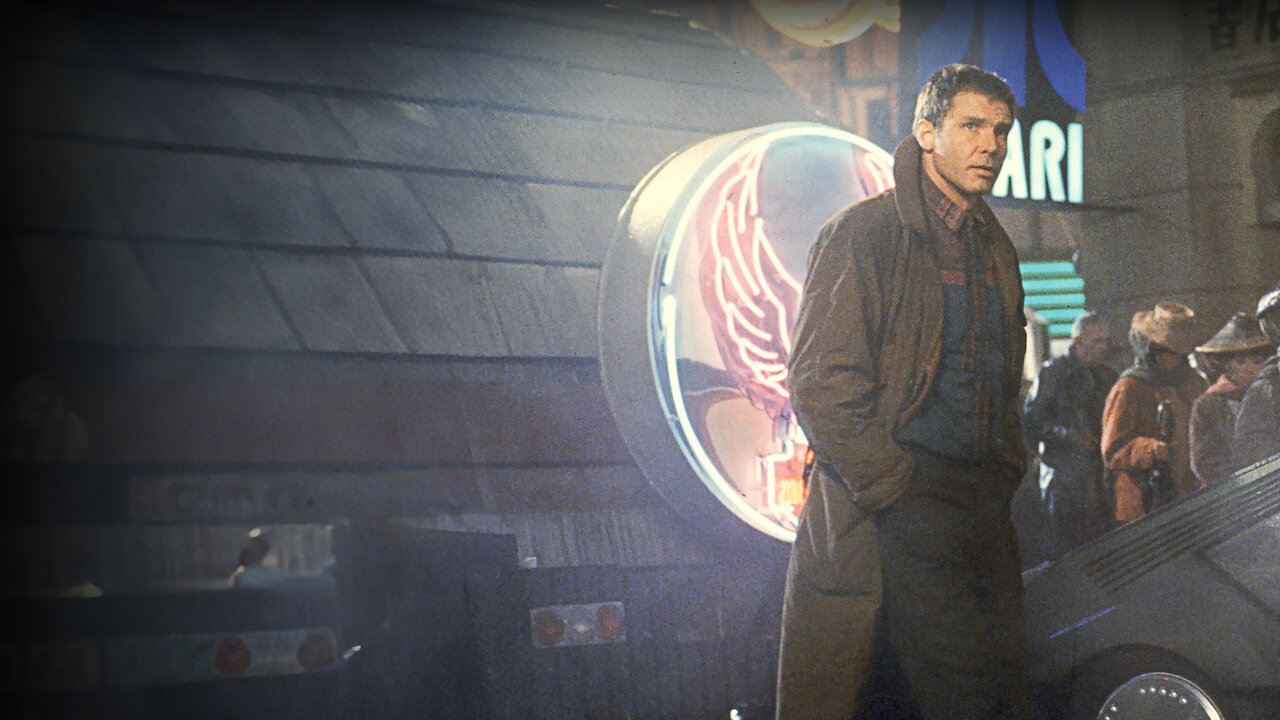
It is hard to quantify the effect that Blade Runner has had on popular culture, let alone the personal impact that it has had on artists and writers, myself included. I recently found myself revisiting Ridley Scott’s masterpiece on a long plane flight where I had nothing but time to ruminate on the film and why I find myself continuously drawn to it even after all these years. It is undeniably a classic film and a staple, if not the staple, of the cyberpunk genre, a sci-fi subgenre that has taken off considerably since the film’s release and spread into other media such as video games and television. A groundbreaking film of its time, Blade Runner has seemingly only become more relevant as time has gone on with its themes of a techno-capitalist-dystopia ruled by mega-corporations feeling all too familiar in the present day. However, that is only a small fraction of what makes this film both magnificent and relevant in our modern age particularly when it comes to the rise of artificial intelligence. Blade Runner at its core is a film that forces audiences to contend with the very idea of what makes us human and more particularly what happens when that quality is absent not just from people but society as well.
To understand the appeal of Blade Runner it is helpful to understand the subgenre that it helped to popularize, cyberpunk. Personally, I feel that this subgenre has become diluted in the present day with people calling media with any semblance of advanced technology and a gritty, noir aesthetic cyberpunk. Cyberpunk does involve advanced technology and gritty themes to be sure, but people often seem to forget about the suffix of cyberpunk, punk. Punk is meant to denote anti-establishment themes, and so cyberpunk does not exist without an establishment in which to position itself against, in most cases corporations or governments. With these inherent revolutionary/anti-establishment themes in mind it bothers me to see the media co-opt the word to simply represent a gritty, techno aesthetic. Cyberpunk exists because it explores the intersection of humanity and technology both on a societal and personal level, and how this intersection can give rise to social revolution and exploration of the boundary of human consciousness. With this in mind it is easy to see why Blade Runner is at the forefront of the genre.
The world of Blade Runner is bleak. Set on an alternate future Earth in Los Angeles, 2021, mankind has migrated to the stars off the backs of replicants: man-made humanoids with advanced strength and intelligence manufactured by the Tyrell Corporation, founded by Dr. Eldon Tyrell. They are used as slave labor on other worlds but illegal on Earth after a replicant combat team mutinied and killed their masters. The story follows a Blade Runner named Deckard, played by Harrison Ford, whose job it is to hunt down rogue replicants who have made their way to Earth and “retire” them. He meets a replicant, Rachael, who has been given memory implants as part of an experiment and was previously unaware that she was a replicant. The two fall in love and by the end of the film, after Deckard has retired all the escaped replicants save for her, choose to run away together. Their fate is unknown until the sequel film Blade Runner: 2049 which I will not be considering in this article.
The heart of this film lies in the concept of the replicant. A man-made humanoid identical to a regular human in every way save for specific enhancements for labor purposes and a built in 4-year lifespan. The lifespan was added as a failsafe lest the replicants live long enough to develop their own emotional responses making them impossible to distinguish from natural humans. In a world where most of all animal life is artificial, being born is a privilege. A privilege that humans are keen on maintaining. Replicants are used for all kinds of purposes ranging from sex work to combat but they are all slaves, unable to live outside of their intended purpose. The 4 replicants Deckard is brought in to hunt down seek to find a way to extend their lifespans and presumably live normal lives. Rachael is different from these 4 in that she was manufactured on Earth and given memory implants, which the others lack, to help her better process emotions and experiences thereby hopefully making her more controllable. This causes Rachael to be unaware of her status as a replicant and fully believe that she grew up and had a childhood with a family. One of the cruelest and most heartbreaking scenes of the film is when she visits Deckard to convince him of her humanity only for Deckard to shatter her world by recounting her own personal memories to her and revealing that they belong to Dr. Tyrell’s niece. The causal cruelty in which Deckard reveals this information to her is disgusting to the audience but not initially to Deckard as he does not see her as a person. It is only after tears well up in Rachael’s eyes does he realize that he may have gone too far. In other words, a strong emotional response convinced him to see her in a different light.
Cyberpunk exists because it explores the intersection of humanity and technology both on a societal and personal level, and how this intersection can give rise to social revolution and exploration of the boundary of human consciousness.
This scene is telling for many reasons. Firstly, it puts into perspective how Deckard and presumably most of this society views replicants and secondly it reminds us just how inhuman humans can be. There is an age-old adage that says, ‘if it looks like a duck, swims like a duck, and quacks like a duck then it’s probably a duck’ and if we were to take this adage to heart then we would most likely treat a replicant like any other person if we were unaware of their background. They are after all indistinguishable from a human with the naked eye. But with one conversation Deckard manages to destroy Rachael’s world, not affording her the same considerations one might give to a human. How could he do that to her? This woman who has done nothing to wrong him and who gives off an obvious air of innocence and desperation to prove her humanity not just to him but also herself. How could he do that to another human-being? I would not presume what people reading this might feel in this situation or how they may feel about Rachael or replicants in general, but I would presume that any decent person would have a hard time being so cruel to something that looks and acts like a person. However, Deckard’s behavior becomes clear when we remember that this is a society built off a class of slaves. A class that Rachael herself belongs to. Blade Runner is about a society of cruelty, of inhumanity, a society lacking compassion even to beings that are exactly like them. A chilling idea to be sure but one that is all too familiar especially with xenophobia on the rise in our world.
This idea also extends into the modern deliberation around A.I. After this encounter, we begin to see cracks in Deckard’s cynical attitude. In a metanarrative sense he develops a class consciousness that sees him realize that replicants are not the true enemy but rather the men and power structures that have set him upon them. With each kill Deckard seems to be less and less sure that what he is doing is right and in a world that draws a clear line between humans and non-humans, having compassion for the other side can be deadly. This growth of a consciousness that Deckard experiences is mirrored in the replicants that he hunts. The 4 replicants, especially the leader Roy Batty, are fascinating characters because they embody humanity and at the same time demonstrate what it means for humanity to be absent in a person. Replicants are pitiable creatures enslaved and forced into submission by their supposed social betters who see them as a disposable commodity. Such is the nature of slavery. They are intriguing for the very fact that their reasons for murdering and escaping are entirely justifiable. How could you blame a slave for revolting against their oppressive masters? This is foiled however by the replicant’s nature. As beings born as adults with only 4 years to live, which they are meant to spend enslaved, replicants lack a past and a future to hope for. Due to this they lack some very basic human qualities. They are seemingly without pity even for those who show them kindness and compassion, they lack empathy, and consistently demonstrate wanton cruelty and manipulative tendencies. Much like some humans I might add. The most human replicant we meet is Rachael who is basically a regular human in attitude and personality due to her memory implants. This is both the crux of the film and the Blade Runner society and poses some very complex philosophical questions. If memories can be implanted artificially into a person how can any of us trust that what we know to be true is true? If Rachael is indistinguishable from a human on all meaningful levels, then who is to say she isn’t a human or at the very least deserving of treatment equal to that of a human? If memories grant the gift of experiences to replicants and that allows them to gain humanity, what is stopping any replicant from becoming human should they live and experience things long enough?
If it looks like a duck, swims like a duck, and quacks like a duck…
The latter question is exactly what Tyrell was afraid of and why he implemented the 4-year lifespan. In fact, it seems that at the 11th hour just before his death, Roy develops full empathy and chooses to save Deckard rather than let him die. He had previously demonstrated small amounts of empathy at the deaths of his companions but to show such a thing for a Blade Runner who had killed his friends and many more of his kind is extraordinary. If we go further down the rabbit-hole we inevitably conclude that there is nothing stopping replicants from becoming fully human and that mankind has essentially enslaved millions of adult children. This is why the 4 replicants, particularly Roy, seek to elongate their lifespans because they have begun to develop their humanity, memories, and will to live. They want to do the most human thing possible; they want to live.
This is to say that all these ideas could also be applied to A.I. There is a question that is troubling to think about: would discrimination against artificial intelligence be socially acceptable if it were to rise to such a place in society to be interacted with on a daily basis? It is not human to be sure; we have no verifiable way of telling if its so-called ‘emotions’ are genuine or even if it is conscious in the first place. Armed with this knowledge would people treat it kindly? Would they afford it the same courtesy as a human? It does, after all, act and speak like a human would but we would all know that it isn’t. What if it gave human responses such as pain and sadness? Would we care or would we chalk it up to programming playing on our empathy? These are not questions that can be easily, if at all, answered but it is all to say that this film has become a troubling thought exercise for the current condition of the world that we find ourselves in.
A core tenant of the cyberpunk genre is the exploration of how technology can divorce us from our humanity. Blade Runner poses the question of what if that technology looked like us? What would a society where corporations have positioned us in opposition to humanity itself look like? Are we perhaps already living in such a society? Through Deckard’s character arc we contend with these complex ideas and feel them as he feels them. As I revisited this film it was almost uncomfortable how much this film feels like it could have been made today. It makes us wonder whether we are careening towards such a society as we find ourselves more and more detached from empathy and compassion. With the rise of A.I., it seems we may soon be coping with more specific aspects of this film, which makes the lessons that we take away from it now all the more important. Blade Runner is a massively important film for our time and one that should be revisited for the sake of culture but also for our own sakes as we increasingly lose the empathy that makes us human in our modern world.
Author’s Note: I watched the final cut of the film which does add some additional scenes and information though I have seen both versions of the film. The additional scenes do change things and how one might view the film, but the overall themes are entirely the same.